
- …
- …
Features
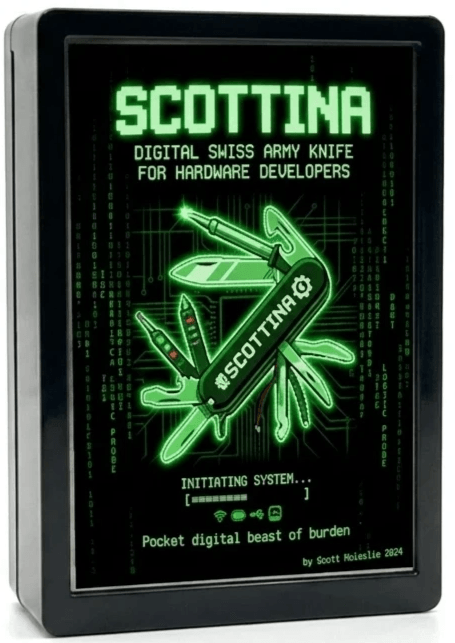
A pocket-sized touchscreen front panel for the bench diagnostic tools you already use — a Pi 5 + 3.5" screen that boots straight to a tap-driven tile grid, strips each tool down to the two controls and two numbers you actually watch, and skips the other 90%. Diagnostics only — not a Flipper, not a Marauder, not a wardriving toy.
Built-in screens (always present)
- LAN Scan — intent-based network diagnostics: Discover / Ports / Services / Identify modes, no raw-flag entry
- Wi-Fi — scan, connect, on-screen keyboard for secured networks; headless join with the IP shown in the header to SSH right in
- Pi Health — temp, CPU, memory, disk, uptime, Wi-Fi signal, throttling
- Tables — on-demand converter service + decode-table store mirror
- Pomodoro — background focus/break timer with app-wide toasts
- Settings — every tunable as a card, power actions, touch calibration
- MicroKVM — off-grid command-plane mirror
Hotplug screens (appears while plugged in)
- CAN Bus — bring-up, bitrate autodetect, live frame counter + frames/s, byte-level change detection, value-match alerting, candump logging
- NMEA2000 — PGN table-driven decode, fast-packet reassembly, range-exit and appearance alerts
- RTL-SDR — frequency scan, rtl_433 ISM decode/identify, IQ capture (RX-only)
- Wi-Fi Sniff — passive airodump-ng monitor capture, uplink watchdog, no injection
- I2C Scan — i2cdetect with best-guess names for responding addresses
- Serial — read-only live view of a USB-serial port at a chosen baud
- Logic Analyzer — FX2LP + sigrok-cli capture
- GPS — PA1616S fix/status
- Files — USB offload of capture logs + DBC/NMEA decode-table exchange
- Light Dock — Scottina Light auto-sync on dock: clock push, decode-table push, black-box log pull
Web-app launch terminals (Minimalistic GIU)
Kismet
Node-RED (4 feedback fields + 4 assignable buttons)
AIS (AIS-catcher RX)
Signal K (helm-glance vitals + live heartbeat)
more coming soon...
USB ACCESSORIES
Boots straight to the tile grid — no keys, mouse, or X server
Renders directly to /dev/fb0, reads touch from the ADS7846 evdev node — nothing that can lose the DRM device
Hotplug detection drives tile visibility; the Pi's own IP is always in the header
Dirty-rect blits + per-screen tick rates keep live screens smooth (~20 Hz) while everything else idles at ~1 Hz
Semiotic-Standard-inspired pictograms so tiles read at arm's length
Scott McLeslie (C) 2023